Struggling to separate complex aromatic or electron-poor compounds using standard C18 columns?
It’s time to move past traditional alkyl phases.
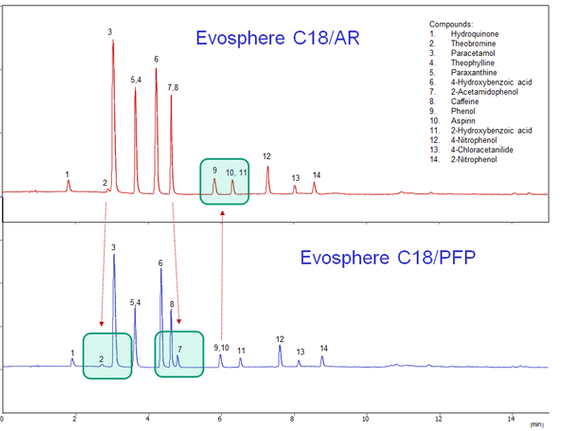
EVOSPHERE C18/AR columns by Fortis Technologies shift the chemistry paradigm by combining classic hydrophobicity with aromatic selectivity. Built on highly efficient monodisperse fully porous particles, it delivers a massive resolution increase precisely where standard methods fail.
Why it deserves a spot in your method development kit:
🔵 Orthogonal Selectivity: Perfect for resolving closely related aromatic rings, heterocycles, benzodiazepines, and molecules with electron-withdrawing groups (halogens, nitriles, nitro groups).
🔵 Monodisperse Particles: Enjoy extreme efficiency and ultra-sharp peaks without the backpressure or loading limitations of core-shell particles.
🔵 100% Aqueous Compatible: Zero phase collapse, even under highly polar, fully aqueous mobile phase conditions.
🔵 High Surface Area (350 m²/g): Delivers superior loadability and seamless scalability from analytical to prep.
Stop settling for co-eluting peaks or messy resolutions. Use a method development workhorse that gives your separation the edge. https://lnkd.in/e9w3Gafk
✔️ Have you tried monodisperse particles in your lab yet? Let’s discuss your trickiest separations.
Monodisperse Particles, Why ?
We have been discussing Evosphere Monodisperse fully porous particles (MFPP) for some time now and people are seeing the benefits in real world applications:
- Increased efficiency
- Increased sensitivity
- Improved resolution
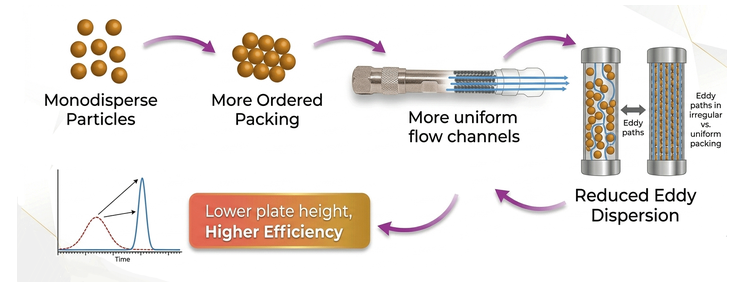
I still get asked on a regular basis how this works. Without going into deep maths and the Van Deemter equation, I think the best way to simplify the explanation is as a causal diagram: